A compact state, a dense economy: Santa Catarina in the age of artificial intelligence
When we think about dynamism, efficiency, and entrepreneurial culture in Brazil, one state deserves particular attention: Santa Catarina.
Not because of its size.
But because of its concentration.
Within a relatively small territory, Santa Catarina brings together diverse productive chains, strong cities, marked regional cultures, and different ways of building businesses.
The state does not depend on a single economic vocation. Its strength appears in agribusiness, fishing, industry, logistics, tourism, real estate, technology, and specialized services.
The West sustains food production, animal protein, and cooperativism.
The Itajaí Valley combines industry, logistics, commerce, and textile tradition.
The coastline brings together ports, fishing, tourism, and real estate.
Greater Florianópolis concentrates technology, innovation, and specialized services.
The South combines industry, energy, mining, ceramics, and coastal culture.
Santa Catarina is small in territory, but dense in capability.
That may be one of the best ways to understand the state.
Its strength is not only in volume, but in combination. In just a few hours, one can cross coastline, valleys, mountains, industrial zones, agricultural regions, and cities shaped by tourism or technology.
This variety helps explain why Santa Catarina developed in such a distributed way, with regions that assumed their own vocations without losing connection to the larger whole.
This density is also cultural.
Before the more recent migratory formations, Santa Catarina was already a territory of Indigenous peoples, with Guarani, Kaingang, and Laklãnõ-Xokleng presence, as well as cultural matrices connected to the Tupi-Guarani universe along the coast.
Later, the coastline came to carry strong Azorean influences, while the interior preserved German, Italian, and other migratory traces.
The result is a state formed by many layers.
Territory, history, culture, and economy overlap around the same thesis:
Santa Catarina is a compact state, but one filled with capabilities and possibilities.
Density as a market thesis
Santa Catarina brings together a rare combination: diverse geography, strong mid-sized cities, specialized industrial sectors, mature agribusiness chains, logistics infrastructure, entrepreneurial culture, and innovation ecosystems.
This distribution does not weaken the state.
It strengthens it.
Instead of concentrating everything in a single axis, Santa Catarina operates in a multipolar way. When one region slows down, another keeps pulling. When one chain matures, another expands. When one sector faces pressure, another gains traction.
There are more support points.
More paths of adaptation.
More economic repertoire available.
This logic becomes clear in the organization of its productive hubs. The state is not defined by a single specialty, but by a network of regional vocations that complement one another.
This is true for industry, agribusiness, logistics, services, and, increasingly, technology.
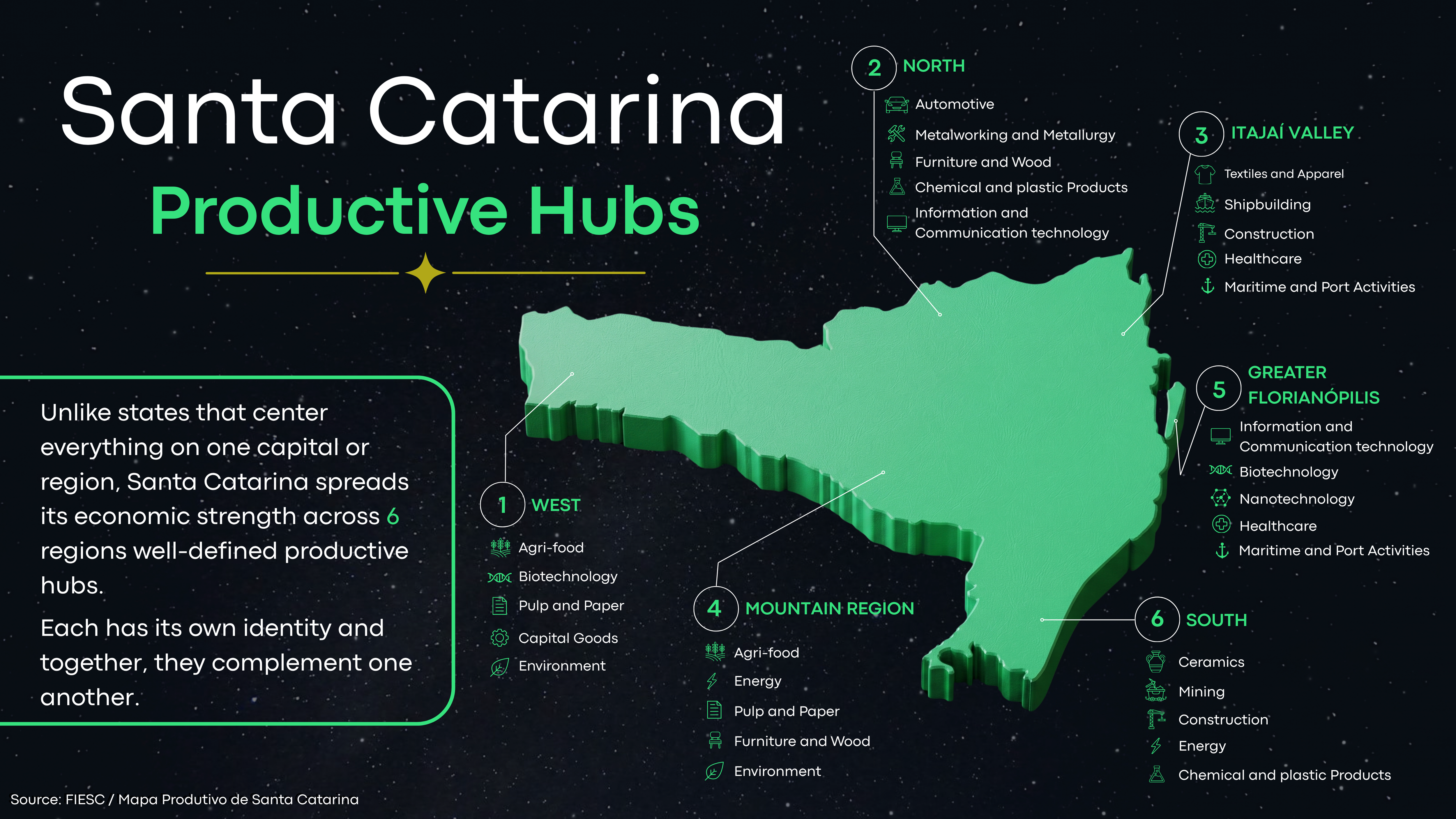
Santa Catarina distributes its economic strength across different productive hubs, forming a multipolar and complementary structure.
The Port of Itajaí as an expression of this logic
This density also appears in the state’s logistics infrastructure.
The Itajaí–Navegantes Complex closed 2024 with 14.17 million tons handled and 1.279 million TEU.
In the same period, the Ports of Paraná handled 66.77 million tons and 1.558 million TEUs.
The comparison is revealing.
With approximately 21% of Paranaguá’s total tonnage, the Itajaí–Navegantes Complex reached roughly 82% of its container throughput.
The point is not to suggest overall superiority of one port over the other.
It is to show something more interesting:
Within a much smaller overall cargo structure, Itajaí–Navegantes sustains a remarkable level of container relevance.
That says a lot about Santa Catarina’s profile.
Coordination, logistical specialization, and the ability to operate with high intensity without relying on territorial gigantism.
It is no coincidence that the Itajaí Valley has consolidated itself as one of the country’s most expressive regions in logistics, foreign trade, and cargo circulation.
Here, density stops being a concept.
It becomes flow.
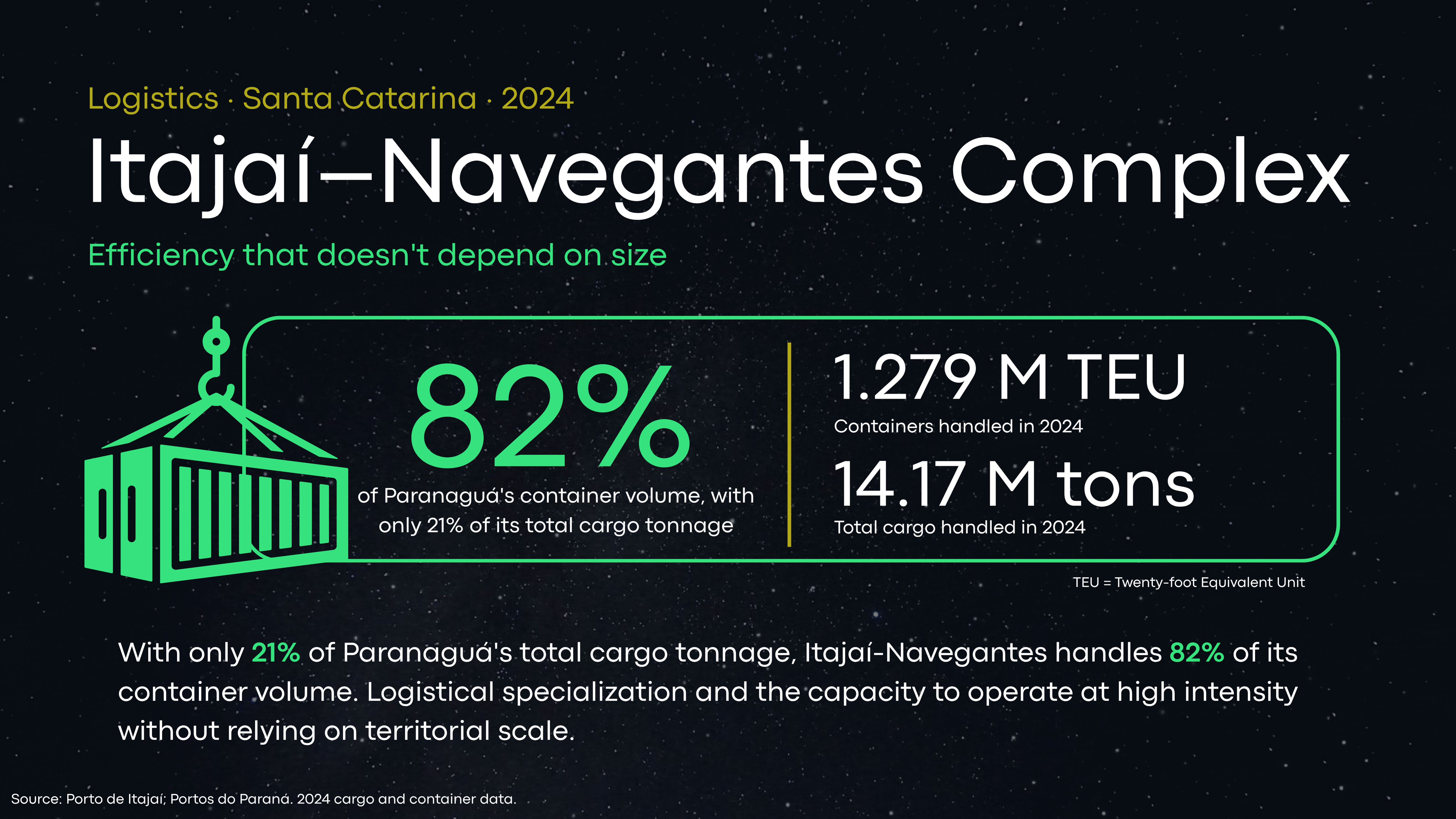
The Itajaí–Navegantes Complex shows how specialization and operational intensity can generate logistics relevance even within more compact structures.
Technology as the maturation of this efficiency
The same pattern appears in technology.
Santa Catarina did not become a technology hub by accident.
According to Observatório ACATE 2025, the state’s technology sector generated R$ 42.5 billion in revenue in 2024, with 11% growth over the previous year, above the national average of 7.7%.
Technology already represents 7.75% of Santa Catarina’s GDP, the third-highest state share in the country. The state also reached the fifth national position in technology revenue.
These numbers point to an important shift.
Santa Catarina is no longer only a productive economy that consumes technology.
It is also a territory capable of creating technology applied to its own demands:
- industry;
- logistics;
- management;
- commerce;
- services;
- agribusiness;
- new digital products.
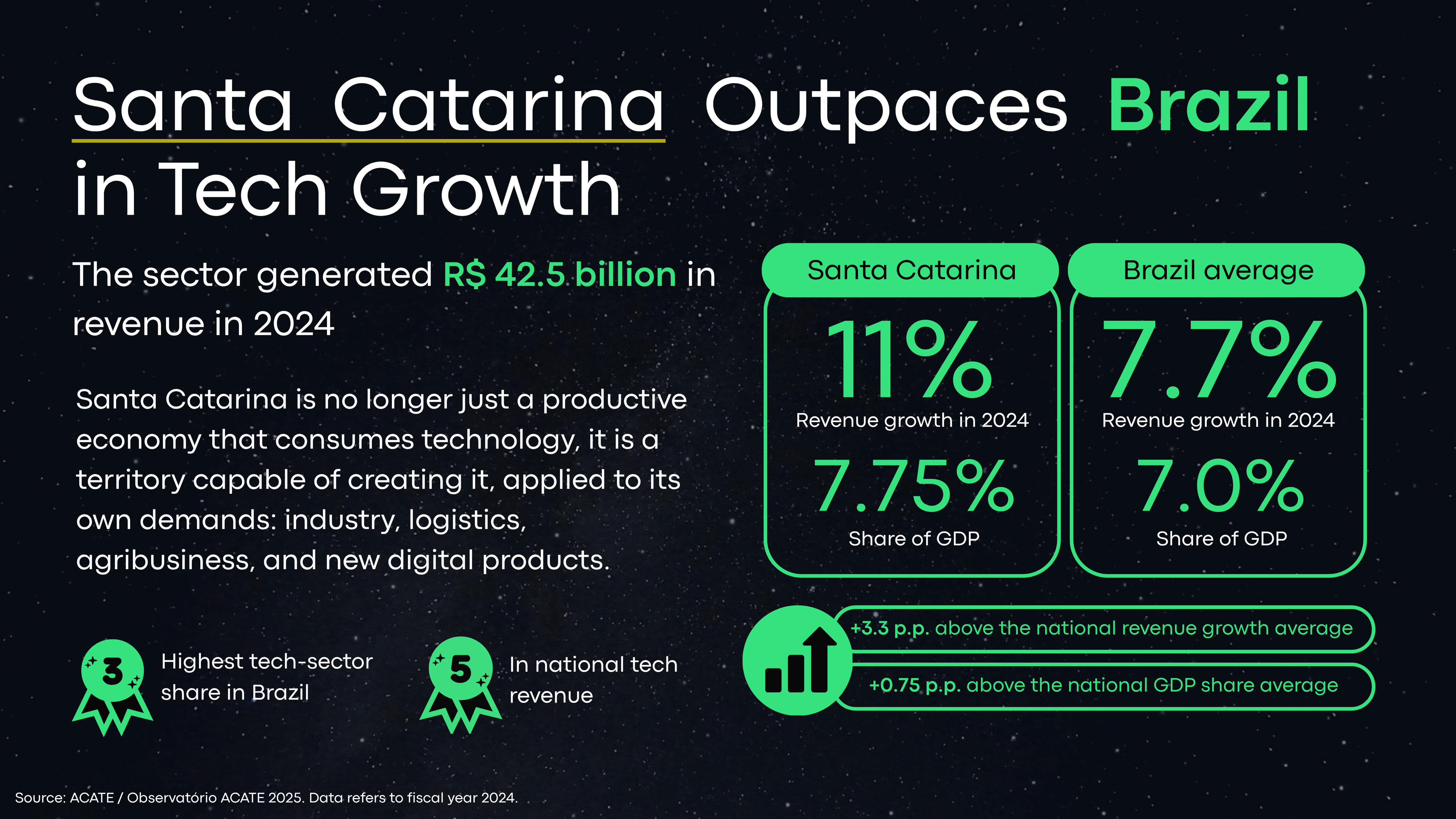
Santa Catarina grows above the national average in technology and consolidates the sector as a relevant part of its economy.
Florianópolis is the most visible expression of this layer.
In the StartupBlink ecosystem ranking, the city appears at #247 worldwide, #6 in Brazil, and #14 in South America, with 214 startups and approximately 18 startups per 100,000 people.
More than a good ranking, this shows that Santa Catarina’s capital has consolidated international visibility within the innovation ecosystem.
Florianópolis works as a showcase.
But Santa Catarina’s strength lies in the whole.
Technology in the state does not depend only on a well-positioned capital. It spreads through a territory that had already turned organization, specialization, and efficiency into competitive advantage.
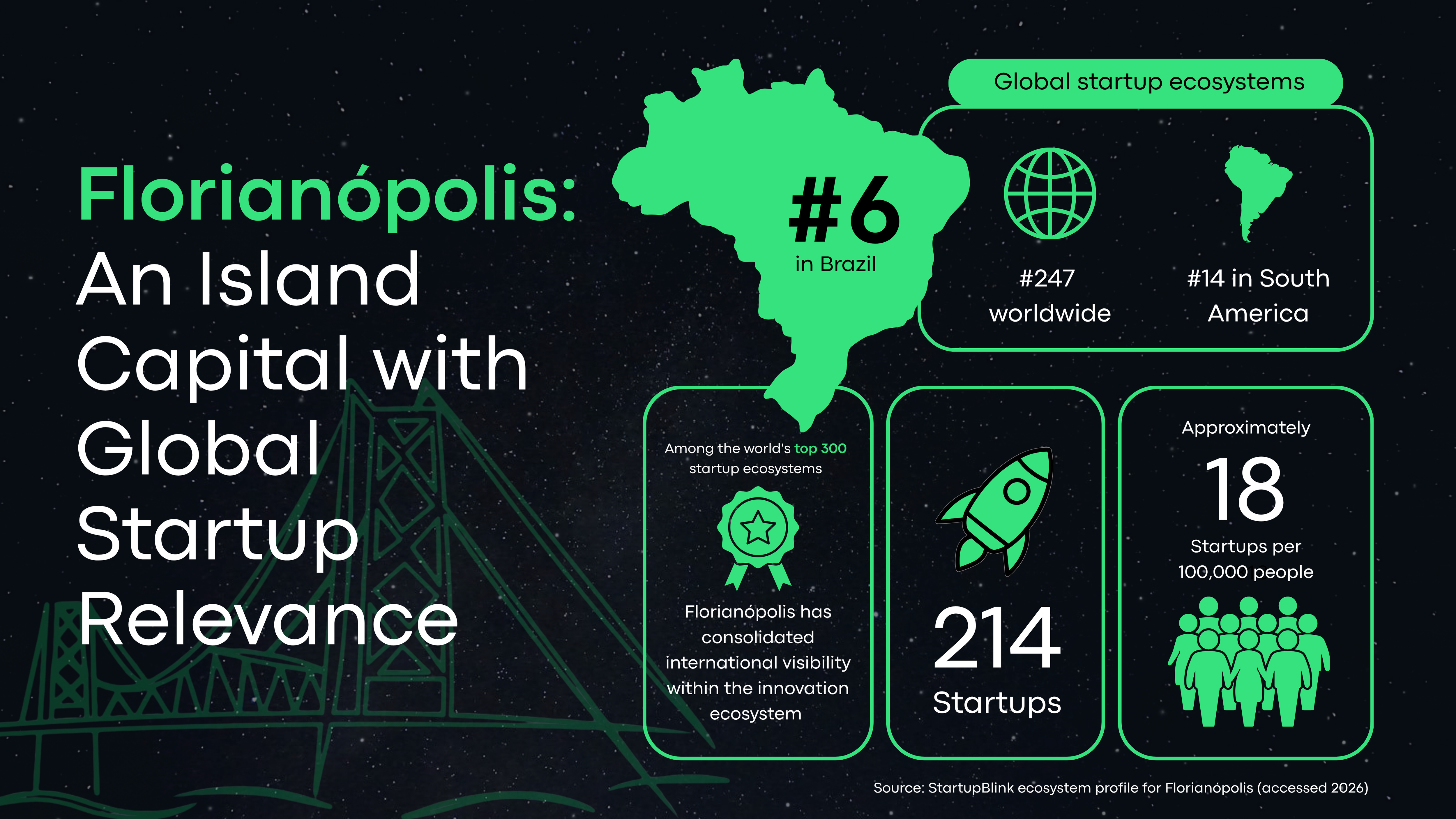
Florianópolis works as the international showcase of Santa Catarina’s innovation ecosystem, but the state’s technological strength is distributed across a broader territory.
AI finds a state already prepared
That is why artificial intelligence finds fertile ground in Santa Catarina.
The state already brings together technical companies, mature chains, lean operations, and sectors that depend on precision in order to compete.
In this context, AI does not appear merely as a trend.
It appears as the continuation of an economy that has already learned to gain density without depending on excess scale.
In Brazil, the IBGE’s Pesquisa de Inovação Semestral showed that the proportion of industrial companies using AI jumped from 16.9% in 2022 to 41.9% in 2024.
The technology has already entered administrative areas, commercial operations, productive chains, and the development of products and processes.
In Santa Catarina, this transition also appears in the labor market.
A study by the State Secretariat for Planning indicated that generative AI is expected to influence 1.24 million jobs in the state, equivalent to 27.6% of occupations exposed to some degree.
The most relevant reading here is not one of shock.
It is one of complementarity.
Much of this impact tends to occur in moderate exposure ranges, in which technology expands productivity, precision, and efficiency

AI adoption is no longer only a technological trend. It is increasingly connected to productivity, occupations, and concrete operations.
The central question, then, is no longer merely access to AI.
It is knowing where it should enter.
In many companies, that opportunity does not appear clearly on the surface. It may lie in a manual routine that consumes hours of the team’s time, in an underused database, in poorly directed service, in a commercial stage that is weakly monitored, or in an internal process with little traceability.
It may also lie in a digital product that needs a more intelligent layer.
That is why the efficient use of AI requires more than choosing a tool.
It requires process reading, technical vision, operational understanding, and the ability to transform a technological possibility into an applicable solution.
The DR Aromas & Ingredients case
The case of DR Aromas & Ingredients — formerly Duas Rodas — in Jaraguá do Sul helps make this movement visible in practice.
The Santa Catarina-based multinational developed its own artificial intelligence platform, DRICA, applied to four fronts:
- customer projects;
- research and development;
- sales forecasting;
- market intelligence.
According to the company and FIESC, the use of the platform helped reduce inventories, expand production capacity, and increase customer satisfaction.
The result appeared in the numbers.
The company recorded 17% revenue growth at the start of 2024, driven by sales and the use of AI.
In 2023, it had already surpassed R$ 1.6 billion in revenue, with 23% of that result coming from its innovation portfolio.
What matters here is not the discourse around digital transformation.
It is the implementation.
In this case, AI does not appear as a decorative layer of technology. It reorganizes decision-making, planning, and operational capacity inside a real industry.
That is the kind of application that matters: technology leaving the field of discourse and becoming method.
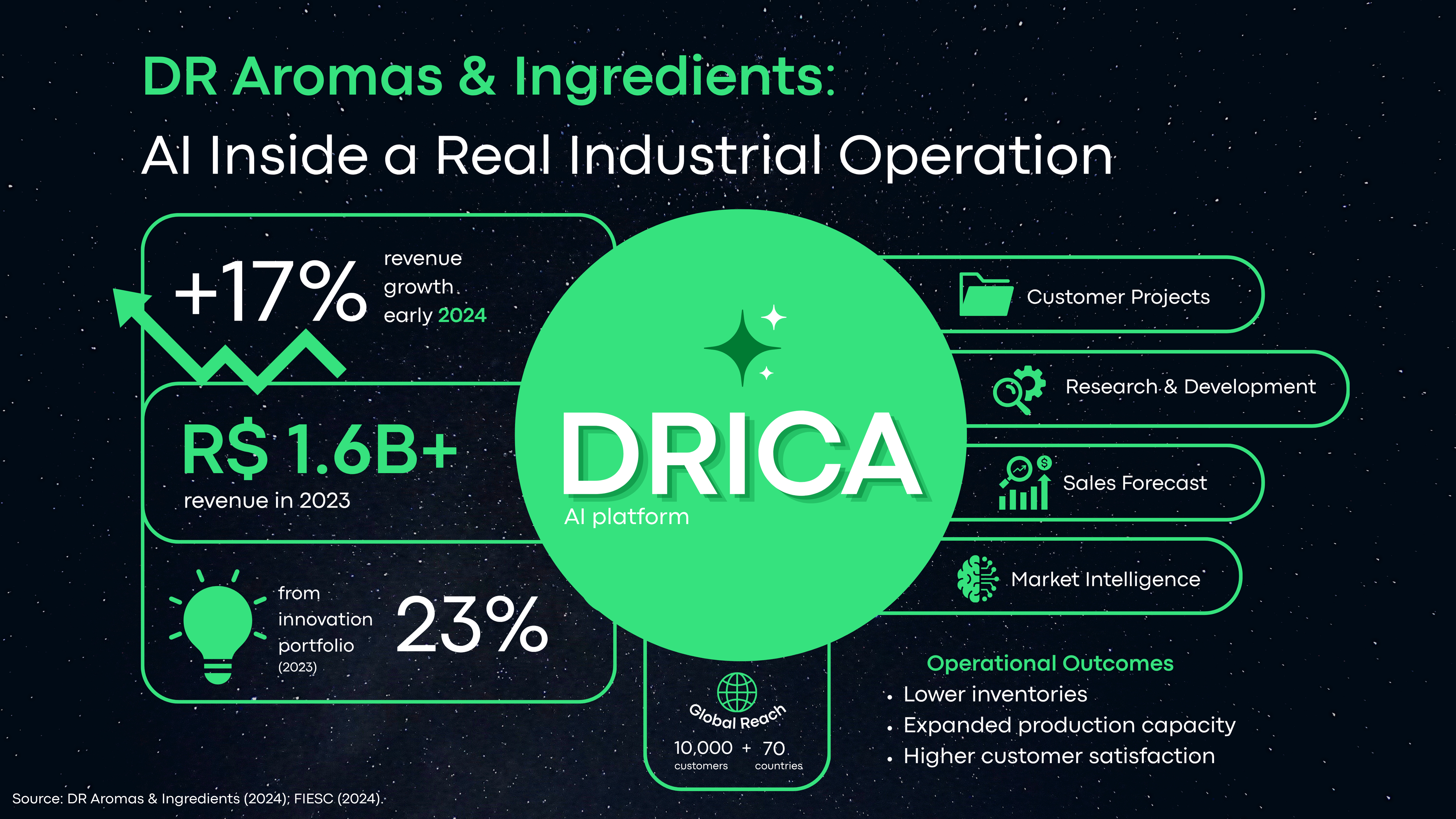
DRICA shows AI applied inside a real industrial operation, connecting customer projects, R&D, sales forecasting, and market intelligence.
From access to mastery
Access to artificial intelligence will become increasingly simple.
Tools, agents, copilots, automations, and generative models are already spreading quickly.
That changes the problem.
The challenge is no longer only to access the technology.
It is to know where it actually improves a company’s ability to operate, decide, sell, serve, produce, or scale.
This transition from access to mastery is decisive.
Any company can start using AI in an isolated way. Incorporating AI methodically, connected to business reality, existing systems, available data, and operational goals, requires a different kind of competence.
At this point, the discussion stops being only about technology.
It becomes a discussion about building capability.
Beyonders as an expression of this DNA
Beyonders was born in Santa Catarina, on the state’s coast, in an environment marked by movement, adaptation, and entrepreneurial capacity.
That origin speaks directly to the way we build technology:
- lean structure;
- high technical standards;
- proximity to the real operations of companies;
- willingness to solve complex problems with method and applied intelligence.
At Beyonders, AI does not enter as innovation discourse.
It enters as part of the method.
It helps us understand operations more deeply, accelerate analysis, structure technical paths, and transform complex problems into more precise solutions.
This is the same logic we see in the state itself:
Doing a great deal with relatively compact structures, without simplifying complexity.
The point is not to adopt technology as aesthetic adhesion.
It is to turn it into practical capability.
A state prepared for the next layer
Santa Catarina may be one of the most interesting places in Brazil to observe this transition.
A multipolar state, relatively compact, yet complete.
A territory of contrasts and complementarities.
Of diverse landscapes, distinct cultures, specialized productive chains, and different ways of building.
That is precisely why artificial intelligence finds such fertile ground here.
It arrives in a state that already knows how to operate with density, efficiency, and adaptation.
And when it finds that kind of base, it stops being merely technological novelty.
It becomes a new layer of real capability.
Lucas Marucci
Business Development and Innovation Executive at Beyonders